Biology Research Paper Guide: Step-by-Step Writing Process
 Mary Watson

Not sure where to begin with your biology paper? A strong approach starts with a focused research question, a clear structure, and evidence from credible scientific sources.
Biology topics often involve dense data, lab work, and technical terminology. Effective papers avoid confusion by keeping explanations clear and organized. This guide shows how to move from a rough idea to a structured research paper that meets academic expectations.
What You Need to Know About a Biology Research Paper
A biology research paper is a formal academic document that explores a question related to living systems. It combines scientific evidence with structured reasoning. These papers rely on peer-reviewed sources, experimental data, and established biological concepts.
Scientific publishing continues to expand. PubMed indexes more than 35 million biomedical articles. This volume highlights the need to filter sources carefully and focus on relevant studies.
Know Your Assignment Before You Begin
Start by reviewing the assignment instructions in detail. Identify required sections, expected length, and citation style. Confirm whether the task involves original lab work or a literature-based analysis.
Students who align their structure with assignment criteria early tend to reduce revision time and improve results. Many instructors evaluate organization and formatting alongside content.
How to Pick a Strong Biology Research Paper Topic
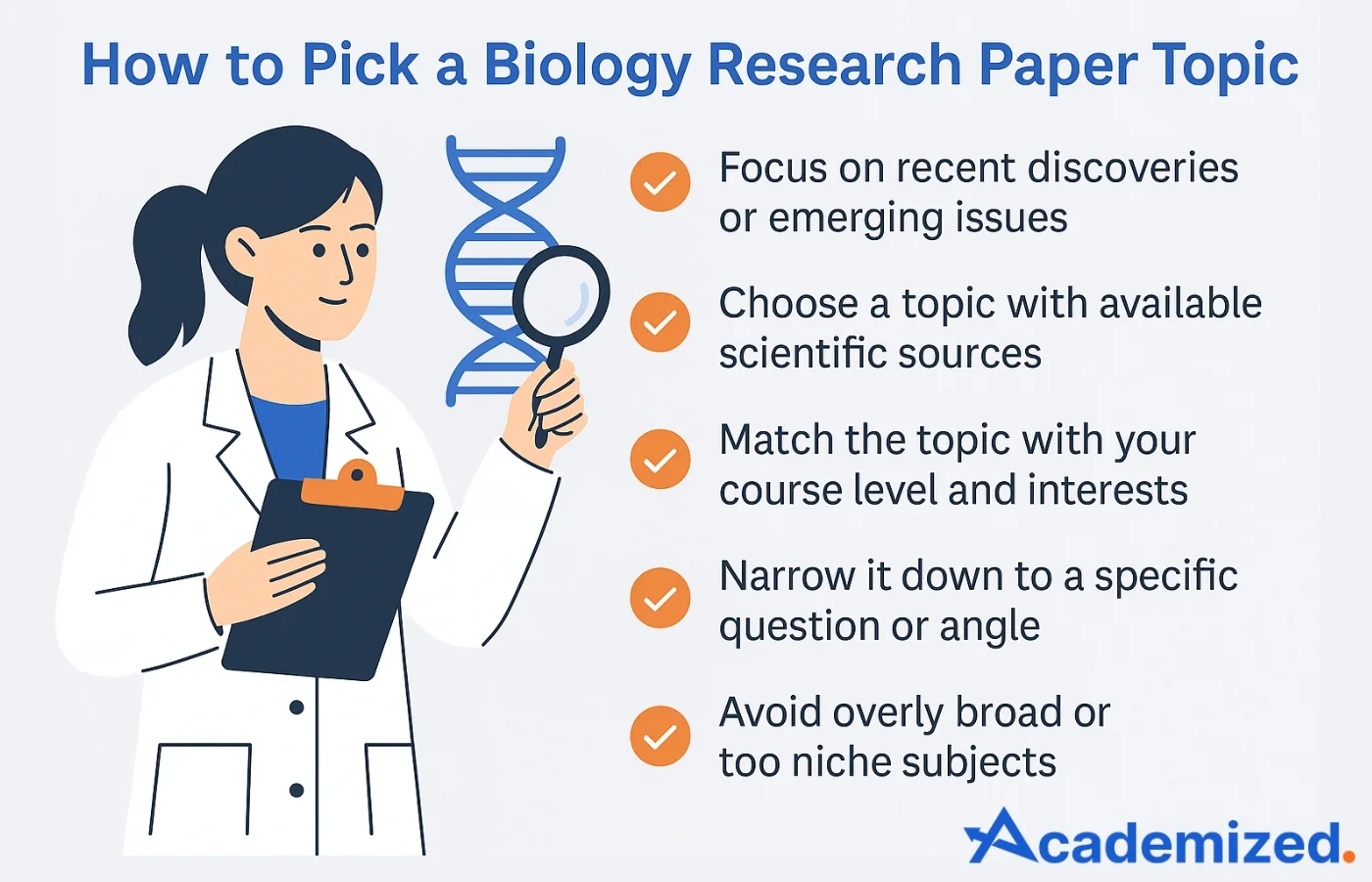
Your topic defines the direction of the entire paper. Choose a subject that is specific, researchable, and relevant to current scientific discussions.
- Gut Microbiota and Human Health
- CRISPR and Gene Editing Ethics
- Coral Reef Degradation and Climate Impact
- Antimicrobial Resistance Trends
- Brain Plasticity After Injury
- Genetically Modified Crops
- Stem Cell Therapy Applications
- Immune Response in Long COVID
- Invasive Species and Ecosystems
- Synthetic Biology in Industry
Global research funding reflects these priorities. Antimicrobial resistance alone is projected to cause millions of deaths annually by 2050 if trends continue, which explains strong research focus in this area.
Doing Research for a Strong Biology Paper
Strong research forms the base of your paper. Use peer-reviewed journals, academic databases, and institutional reports. Focus on recent publications unless older studies are essential.
Scientific journals use peer review to ensure accuracy. Articles indexed in major databases carry higher credibility and are widely cited in academic work.
Track your sources carefully while reading. Organized notes reduce citation errors later.
Looking for reliable academic help? Academized.com is a time-tested website that writes your essays, and our experts are always ready for a challenge.
Developing Your Biology Paper’s Research Focus
Once you’ve reviewed your sources and thought through your topic, the next step is defining your paper’s direction. This usually means writing a research question or a hypothesis. A question helps guide exploratory research, while a hypothesis is more useful for experimental or data-based work. Your focus should be specific enough to explore in detail but not so narrow that you run out of material. A straightforward, well-framed question or testable hypothesis gives your paper structure and helps you stay on track as you analyze your findings.
Build a Basic Biology Research Paper Outline
An outline organizes your ideas before drafting begins. It ensures each section supports your main argument.
This table provides a quick reference for structuring the paper and helps maintain logical flow.
Read more: Learn How to Write a Sociology Research Paper
Begin With a Title and Abstract
Your title should reflect the focus of the study. Keep it direct and specific. The abstract follows with a concise summary of purpose, methods, and results.
Most academic journals limit abstracts to 250 words. Clear abstracts increase the chance that a paper will be read and cited.
Create a Biology Research Paper Introduction
The introduction moves from a general topic to a focused research question. Provide background information and explain why the topic matters.
End with a clear thesis or hypothesis. This statement sets expectations for the rest of the paper.
Background or Literature Review
This section places your research within the broader scientific context. Compare previous studies and identify gaps your work addresses.
Recent reviews show that replication challenges remain an issue in science. Addressing these gaps adds value to your research.
Methods and Materials
Describe how the study was conducted. Include sample details, tools, and procedures. Write this section with precision so another researcher could replicate the process.
Reproducibility remains a key issue in scientific research. Clear methods improve reliability and credibility.
Results Section
Present findings without interpretation. Use tables, charts, or figures when working with large datasets.
Data visualization improves understanding. Readers process structured visual data faster than plain text.
Discussion Section
Interpret your findings and connect them to your research question. Compare your results with existing studies and explain similarities or differences.
Address limitations such as sample size or experimental conditions. A strong discussion acknowledges these factors and explains their impact.
Conclusion
Summarize the main findings and explain their significance. Focus on how the results contribute to the field and what future research might explore.
Concise conclusions help readers retain key insights and understand the broader relevance of the work.
References and Citations
List all sources used in the paper. Follow the required citation style consistently. Ensure in-text citations match the reference list.
Incorrect citations reduce credibility. Consistent formatting reflects attention to detail.
Appendices and Visual Elements
Include supplementary material such as raw data or extended tables in an appendix. Visual elements should support findings without disrupting flow.
Figures and diagrams improve engagement and help explain complex biological processes.
Read more: Master Writing a Strong Psychology Research Paper
Editing and Proofreading Tips
- Read the paper aloud to identify unclear phrasing
- Check logical flow between sections
- Shorten long sentences
- Verify table and figure references
- Review citation formatting
- Ask for feedback before submission
Editing improves clarity and coherence. Even strong research loses impact without careful revision.
Common Biology Paper Mistakes
- Missing research focus
- Irrelevant background information
- Incomplete method descriptions
- Weak connection between results and discussion
- Improper citation
- Ignoring formatting rules
These issues appear often in student submissions and affect final grades.
What Sets Biology Research Papers Apart
Biology research papers stand out because they rely on evidence drawn from observation, experimentation, or scientific literature to answer specific questions about living systems. These papers don’t just explore ideas; they examine real data and explain what it means in a broader biological context. The structure follows a strict scientific format, and accuracy matters as much as clarity. Unlike essays in other disciplines, biology papers require you to describe methods precisely, report results without personal bias, and connect your findings to existing knowledge. Whether you're analyzing cell functions, ecosystems, or genetic patterns, your goal is to build a logical, factual explanation that’s supported by research and presented with precision.
Need help with some other assignment? Busy students often ask us, “Please do my lab report,” or request assistance with math, science, or other tricky disciplines. We welcome all student queries, so no subject or topic poses a problem!
Final Format Checklist
- Title page is complete
- Abstract summarizes the study clearly
- Sections follow logical order
- Citations match references
- Formatting meets guidelines
- Figures are labeled correctly
- Terminology is consistent
- Grammar and spelling are checked
Final Insights
Writing a biology research paper becomes manageable when broken into clear steps. Focus on one section at a time and keep your research aligned with your main question.
Strong papers explain complex topics in a direct and structured way. Clarity and precision shape how your work is evaluated.
FAQ
What structure should a biology research paper follow?
Most biology research papers follow a scientific format with a title page, abstract, introduction, methods, results, discussion, conclusion, references, and sometimes appendices. Each section serves a specific purpose and helps guide the reader through your work logically.
How should I start a biology paper?
Start with a sentence that introduces the topic broadly and leads into your specific research question.
Example: Environmental toxins have been shown to affect reproductive systems across species. This paper explores their effects on amphibian development in freshwater habitats.
How should I end the paper?
End by restating the significance of your findings and suggesting what future studies could build on.
Example: The results highlight the sensitivity of amphibian larvae to small pollutant concentrations, suggesting the need for stricter water quality guidelines and long-term monitoring.
How long does it take to write a biology research paper?
Timing depends on the assignment length, topic complexity, and whether lab work is included. On average, a well-researched paper takes about one to two weeks from topic selection to final edits, longer if experiments are involved. Starting early gives you room to revise and reduces last-minute stress.
Mary, our exceptional editor and online tutor, brings a wealth of knowledge to the table. With her extensive expertise in academic writing, she guides and mentors aspiring students, providing them with constructive feedback that propels their essays to the next level.