How to Write a Psychology Research Paper
 Mary Watson

Want to learn how to write a psychology research paper that earns a solid grade? Writing a paper in psychology is about building a clear, evidence-based argument and presenting your ideas in a format that matches academic standards.
Our team knows psychology writing involves research, structure, and analysis working together. This guide breaks the process into manageable steps so you can move from topic selection to the final draft with a clear plan.
What Constitutes a Psychology Research Paper?
A psychology research paper is a structured academic report focused on a topic within psychology. It investigates theories, behaviors, or mental processes through reliable evidence and critical analysis. These papers often take the form of an original study, a literature review, or a case study. Whether you are exploring memory, attention, or the effects of social media on self-esteem, your goal is to explain findings through a scientific lens.
Need a hand with a psychology research paper? Writers and researchers who offer essay writing services at Academized are skilled and ready to help at any stage of the writing process.
First of All, Make Sure to Understand the Assignment
Before you begin drafting, make sure you understand what your instructor expects. Read the prompt more than once and mark the key requirements. Check whether you need to conduct research, review existing studies, build an argument, or critique findings.
Look for required sections such as an abstract, method, results, and discussion. Review the rubric as well. Many grading rubrics in psychology place strong weight on structure, evidence use, and correct citation style. A careful read at the start saves time during revision.
How to Write a Psychology Research Paper Like a Pro Writer
Planning a strong psychology paper takes more than typing out ideas. Strong papers begin with focused choices and a clear direction. The steps below help you shape the process from the beginning.
Decide on a Relevant and Exciting Research Topic
A strong topic makes the paper easier to manage and more interesting to write. Choose something specific, relevant, and supported by enough research.
Recent themes in psychology offer useful starting points. Mental health, technology use, addiction, and trauma remain common areas of study. Psychology remains one of the most popular social science fields in higher education, which means there is a large body of published work to draw from when selecting a topic.
- The Effects of Social Media on Adolescent Mental Health
- Cognitive Behavioral Therapy for Treating Anxiety
- Sleep Deprivation and Memory Retention in College Students
- The Psychology of Online Shopping Behavior
- How Childhood Trauma Influences Adult Relationships
- Virtual Reality in Exposure Therapy
- Mindfulness Practices and Academic Performance
- Implicit Bias in Law Enforcement Decisions
- The Role of Dopamine in Addiction
- Psychological Impacts of Climate Change Awareness
Do a Scrupulous Literature Review
A literature review helps you understand what researchers already know and where important gaps remain. This step is more than gathering sources. You need to compare findings, note patterns, and track disagreements across studies.
Start with academic databases such as PsycINFO, Google Scholar, or your university library. As you read, take notes on research methods, sample sizes, results, and limitations. Keep your focus on recent work unless you need to reference a foundational theory or landmark study.
A useful review also helps you avoid a weak topic. If there is too little research, your paper may lack support. If there is too much broad research, narrowing the question becomes essential.
Develop a Clear Research Question and a Valid Hypothesis
Every strong psychology paper begins with a focused research question. It should be specific, clear, and possible to answer through research. Broad questions produce scattered writing, while focused questions give the paper direction.
Once the question is set, create a hypothesis based on the studies you reviewed. Your hypothesis should state what you expect to find and give readers a clear sense of the relationship you plan to examine.
Create a General Psychology Research Paper Outline
Planning the structure early makes drafting easier. An outline acts as a working map for the paper and helps you keep each section connected to the main argument.
Most psychology papers follow a predictable format. This is one reason clear planning matters so much. In many undergraduate courses, structure errors lower grades even when the topic itself is strong.
Sample Outline
- Title Page
Title, name, institution, date - Abstract
A 150 to 250 word summary of the study, methods, and findings - Introduction
Background, research question, and hypothesis - Method
Participants, materials, and procedures - Results
Data, tables, and basic statistical findings - Discussion
Interpretation, limitations, and future directions - References
All sources in APA format
Follow a Logical Psychology Research Paper Structure
A psychology paper should move in a clear order from research problem to findings and interpretation. Readers should understand what each section does and why it appears where it does.
This table adds a quick planning reference. It helps students see what belongs in each section before drafting begins.
Create a Well-Formatted Title Page
The title page gives the first impression of your paper. Include the title, your name, institution, course, instructor, and submission date. Use APA format unless your instructor gives different directions.
Keep the title specific. Readers should understand the topic at a glance without reading the full paper.
Write an Accurate Abstract
The abstract gives readers a short overview of the study. Write it after the rest of the paper is complete so the summary matches the final content.
Most psychology abstracts fall within 150 to 250 words. In a compact space, you need to summarize the purpose, method, main findings, and broader importance of the paper. Avoid citations and long explanations here.
Start with a Strong Psychology Research Paper Introduction
An effective introduction explains why the topic matters and what question the paper addresses. Begin with background information relevant to the study. Then move toward the problem or gap in the research.
The final sentence of the introduction should state the hypothesis clearly. A focused introduction makes the rest of the paper easier to follow.
Do Not Skip the Method Section
The method section explains how the research was conducted. Readers should understand who took part, what materials were used, and how each step happened.
Break it into participants, materials, and procedure. Include details such as age group, sample size, recruitment method, and study tools where relevant. Clear reporting matters because psychology relies heavily on replication and transparent methods.
Make Sure Your Body Paragraphs Stay Focused
Each body paragraph should develop one idea linked to your thesis or research question. Start with a topic sentence, support it with evidence, and explain how the evidence fits your argument.
Avoid stuffing several unrelated points into one paragraph. Strong paragraphing improves readability and helps readers follow your reasoning without confusion.
Read more: Guide on Writing an Analytical Essay
Highlight the Results
The results section presents what you found without interpretation. Keep the tone neutral and focus on the data. If your paper includes numbers, tables or figures improve clarity.
Many student papers lose marks here because they begin analyzing results too early. Save interpretation for the discussion. In the results section, accuracy and organization matter most.
Offer Deep Thoughts in the Discussion Section
This section explains what the results mean in relation to the research question. Connect your findings to earlier studies and explain whether they support or challenge past work.
You should also address limitations. For example, a small sample size, one campus setting, or self-reported survey answers all affect how widely the results apply. A good discussion shows maturity by acknowledging those limits instead of ignoring them.
Finish with a Convincing Psychology Research Paper Conclusion
A strong conclusion brings the full paper together and reinforces why the findings matter. Briefly return to the research question and summarize what the results show.
Then point to the larger meaning of the work. Your findings might matter for future studies, clinical practice, school policies, or public understanding of behavior. Keep the conclusion focused on relevance and closure rather than repetition.
Make Sure to Mention All the References
Citing sources correctly is essential in psychology writing. Include every source you cited in the paper and remove anything unused. Follow APA rules for author names, publication year, title formatting, and source details.
Reference list mistakes are common in student writing. Small errors in punctuation, italics, or capitalization affect presentation and lower the paper’s polish.
Put Together the Appendices, if Needed
If the paper includes surveys, interview questions, raw data, or lengthy supporting material, place them in an appendix. This keeps the main discussion clear while still showing the supporting material used in the study.
Label each appendix clearly and mention it in the main text when relevant.
Revise, Edit, and Proofread Carefully for a Finished Look
Once the draft is done, step away from it for a short time before revising. A fresh read makes weak phrasing and structural issues easier to catch.
During revision, check whether each paragraph supports the thesis. During editing, improve sentence flow and remove clutter. During proofreading, correct grammar, spelling, punctuation, and formatting. Reading the paper aloud helps many students catch awkward wording.
Need a cheap research paper writer fast? Drop us a line or fill out the order form at Academized to get qualified academic help from verified writers.
Stick to the Right Psychology Research Paper Format
A psychology paper usually follows APA guidelines. These rules make the paper consistent and easier to read.
- Use standard 8.5 x 11 inch paper
- Double-space all content, including references
- Use a clear font such as 12-point Times New Roman
- Include 1-inch margins on all sides
- Add a page header with a shortened title and page number
- Use APA-style headings
- Indent the first line of each paragraph
- Include a title page, abstract, main body, and references
APA style remains the standard format in psychology courses and journals. Learning it early helps across multiple assignments.
Do This When Preparing for Publication
If you plan to submit your work to a journal, study the target journal’s submission rules carefully. Read recent articles to understand tone, structure, and citation style.
Journal editors look for clean organization, strong methods, and clear writing. Student research has a better chance of being noticed when it links the topic to a current debate in the field and presents the findings with precision.
Still Have Questions? View this Psychology Research Paper Example
Seeing a sample helps many students understand how the parts fit together. The short example below shows a simple psychology paper structure.
Title: The Impact of Social Media Use on Adolescent Self-Esteem
Abstract
This study examines how daily social media usage affects the self-esteem of high school students aged 14 to 18. Using survey data from 150 participants, we analyzed patterns of usage, emotional responses, and self-reported self-esteem scores. Results showed that teens who spent more than three hours per day on social platforms reported lower self-esteem levels than those who spent less than one hour. The findings point to a clear link between digital habits and psychological well-being.
Introduction
The relationship between social media and self-image has received growing attention in recent years. Adolescents spend substantial time online, and this pattern has raised concerns about social comparison, body image, and self-worth. This paper explores whether frequent social media use is associated with lower self-esteem among teenagers.
Method
Participants were 150 high school students from urban and suburban areas. Each student completed a questionnaire about daily time spent on platforms such as Instagram, TikTok, and Snapchat. They also completed the Rosenberg Self-Esteem Scale, a widely used measure of self-worth in psychological research.
Results
Students who reported more than three hours of daily social media use scored an average of 14.2 on the Rosenberg scale, compared with 18.7 for those using social media less than one hour daily. The data showed a moderate negative correlation between time spent online and self-esteem levels.
Discussion
The findings suggest a meaningful association between higher social media use and lower self-esteem in adolescents. The study does not prove causation, though it does support concerns about excessive screen time and negative self-perception. Future research should examine content type, comparison habits, and peer feedback more closely.
Analysis
This sample stays focused and follows a clear research structure. The introduction frames the issue, the method explains the process, and the discussion links the results back to the main question. It remains professional without relying on complex wording.
Expert Tips from Our Top Academic Writers
Once the foundation of the paper is in place, a few practical habits improve the final result. These tips help students strengthen clarity, structure, and academic tone.
- Start early so you have time to revise more than once
- Keep your thesis focused throughout the paper
- Remove filler language so each sentence serves a purpose
- Use terminology consistently
- Check every reference for correct APA formatting
- Use only relevant evidence
- Add headings to improve navigation
- Read published studies for structure models
- Ask for feedback before submission
Read more: Tips for Writing a Strong Research Paper
Look Out for These Sneaky Mistakes
Even strong students miss details that weaken a paper. The mistakes below appear often in early drafts.
- Writing without a clearly defined research question
- Forgetting to cite sources or citing them incorrectly
- Mixing summary and analysis in the discussion
- Relying on outdated or weak sources
- Using casual language in a formal paper
- Skipping the abstract or leaving out key parts
- Ignoring proofreading and formatting checks
- Missing the rubric or assignment instructions
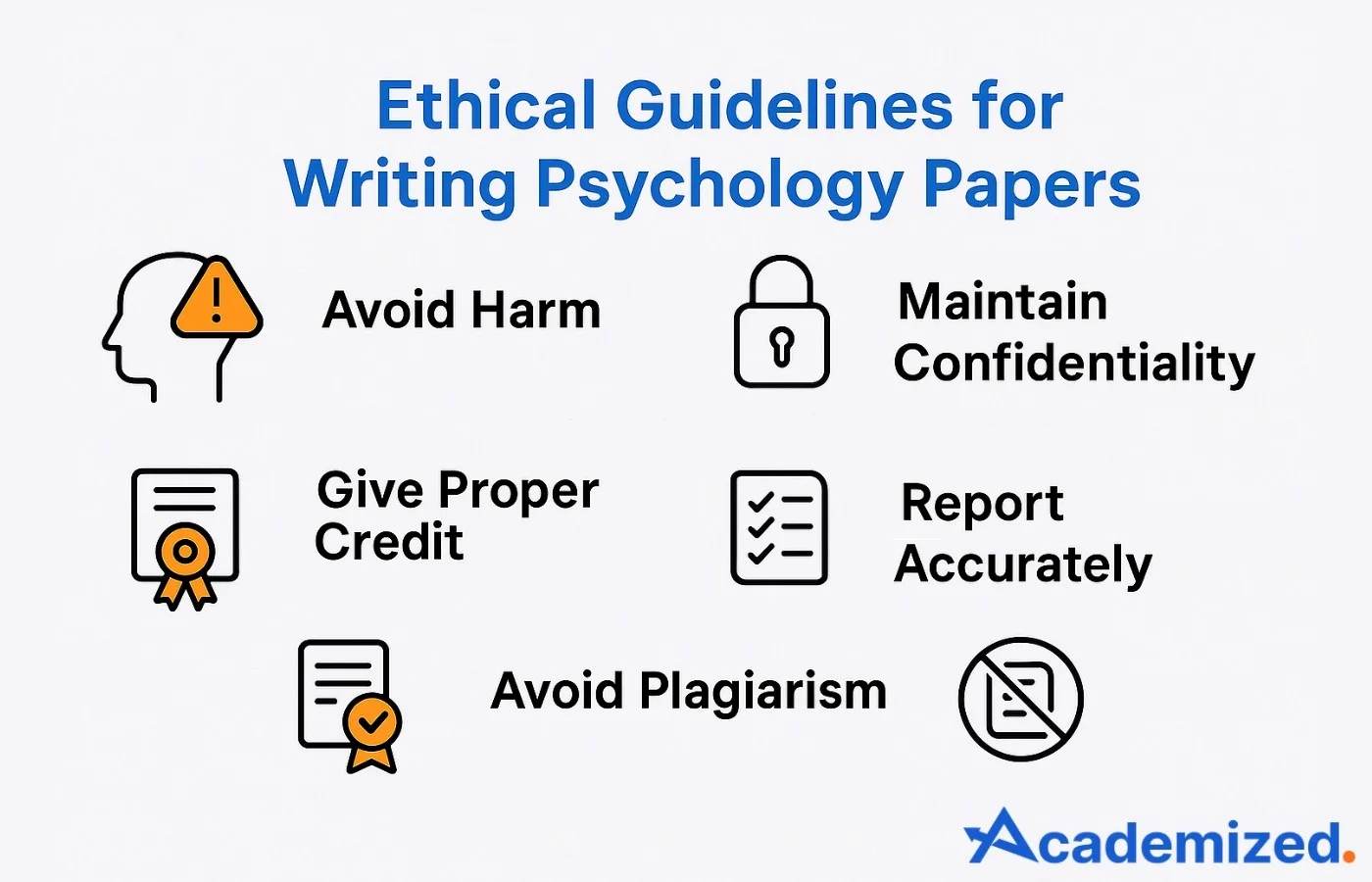
Be Mindful of the Ethical Guidelines in Psychology Writing
Ethics play a central role in psychology. Present data truthfully and avoid misrepresenting sources or results. If your paper includes original data collection, protect participant consent and confidentiality.
Ethical standards matter in writing as much as they do in research design. Papers lose credibility fast when evidence is selective, manipulated, or copied without proper citation.
Concluding Personal Insights From the Author
When I first started writing psychology papers in college, the structure felt rigid and the language felt difficult. Over time, I learned a simpler lesson. Strong papers depend more on clarity and consistency than on sounding formal for the sake of it.
One lesson stayed with me through every paper I wrote and reviewed. Each section has its own job, and the paper works best when those parts stay connected without blending into each other. A clear introduction matters. A careful results section matters. Revision matters even more than many students expect.
If there is one point worth keeping in mind, it is this. Psychology research paper writing does not need to feel complicated. It needs focus, logic, and careful analysis. Each paper helps build the next one.
Read more: Learn How to Write a Visual Analysis Essay
FAQ
What are the primary research methods used in sociology?
Sociology often relies on surveys, experiments, observational studies, and content analysis. Each method offers a different way to examine social behavior and draw conclusions about human interaction.
How can I effectively begin a sociology research paper?
Start with a brief introduction to the topic, explain why it matters, and end with a focused thesis statement.
Example: Social media platforms have reshaped communication patterns worldwide. This paper explores how these changes affect self-esteem among adolescents, with attention to age and gender differences.
What’s a strong way to wrap up a sociology research paper?
Your conclusion should revisit the main findings, explain their meaning, and point to future research directions without repeating earlier wording.
Example: These results show a connection between online behavior and self-image in teens. Further research should examine how cultural expectations shape these trends across different settings.
How is a sociology research paper usually organized?
- Title Page
- Abstract
- Introduction
- Literature Review
- Methods
- Results
- Discussion
- Conclusion
- References
Mary, our exceptional editor and online tutor, brings a wealth of knowledge to the table. With her extensive expertise in academic writing, she guides and mentors aspiring students, providing them with constructive feedback that propels their essays to the next level.